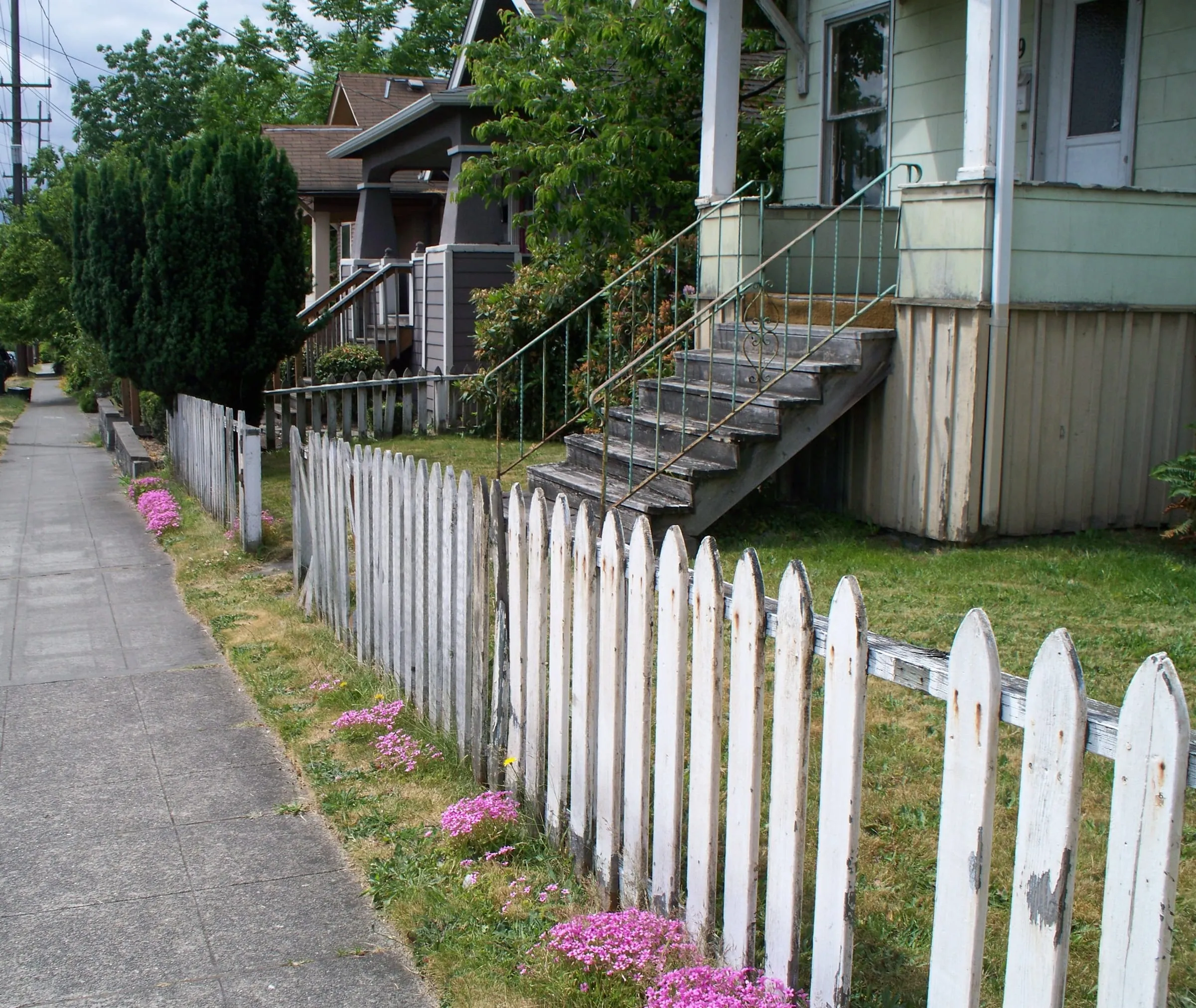
Can a fence go right on the line?
In most of the area, yes, as long as it stays on your side. Oconee County lets a fence stand in any setback if it remains on your property, and Pickens County sets no minimum fence setback.
The exact rule depends on the office:
- Unincorporated Oconee County. Sec. 38-9.3(2) lets fences stand in any setback “so long as they remain on the property.” Corners and driveways need a clear sight triangle with 25 ft legs, with nothing 2.5 to 8 ft high inside it.
- Unincorporated Pickens County. UDSO Sec. 409(b)(1) sets no minimum fence setback, but a fence can’t stand in a right-of-way or a public access easement, or block the view at an intersection.
- City of Clemson. Sec. 19-305 C.11 allows fences on side and rear lines, but no closer than 18 in to a street right-of-way, and the finished side faces the exterior property line.
- City of Seneca. Sec. 720 and Sec. 721 keep corners and driveways clear for drivers.
“On your property” includes the posts and the concrete around them, so plan the line a little inside the pins rather than on top of them. Fence permits and rules, town by town covers each office in full.
Do I need a survey?
Only if you can’t find your corner pins or aren’t sure where the line runs. National cost guides put a boundary survey at roughly $200 to $1,000.
Start with your plat or an old survey, which shows the corners and the length of each line. Pins are metal markers at the corners and can sit under grass, mulch or leaves. If you find them all and they match the plat, string a line between them and you have your boundary. If a pin is missing, a corner looks wrong, or a neighbor sees it differently, a surveyor can find or reset the pins before any post goes in. How to measure your yard for a fence picks up from there.
Who pays for a fence on a shared line?
As a rule, it comes down to what you and your neighbor agree. If you split the cost, put it in writing before work starts.
Talk to the neighbor before the stakes go in, even if you are paying for all of it. A fence on the line is something they live with too. If you share the cost, write down:
- where the fence sits, measured from the pins
- who pays what, including gates and any removal
- which side faces out
- who maintains it, and how repairs are split
- what happens if one of you sells
The finished side faces out on every fence we build. In Clemson, the code requires it.
What about HOA rules?
Some HOAs control fences on lot lines and need to approve them first. Keowee Key’s covenants, Art. III.F, allow no fences, hedges or walls on property lines without approval from its review committee, CARE.
At Keowee Key, a fence below 804 ft of elevation needs approval from both CARE and Duke Energy. Other neighborhoods have their own covenants, so ask for yours and for the approval form before you choose a style or a line. Get the approval in writing. Before a layout is final, we check the HOA rules along with the town, county and lake rules.
Where is the line on Lake Hartwell?
At the Corps of Engineers boundary, which you have to find yourself. Painted trees mark it only roughly; the line runs pin to pin and is based on the 670 ft elevation.
The Corps’ Shoreline Management Plan (2020), Sec. 20.a, puts finding the line on the owner. Under Sec. 20.b, building on public land without a permit is trespass or encroachment, and the plan bans items that suggest private ownership, including invisible dog fences. Call the Hartwell lake office at 706-856-0300 before you plan a fence toward the water. Our Lake Hartwell fence page has more on lake lots.
And on Lake Keowee?
Stay above Duke’s Project Boundary. Duke’s Shoreline Management Guidelines do not approve fences inside it, except to keep livestock watering to a small area of the shoreline.
The boundary elevation varies by tract, so check the line for your lot rather than assuming one figure. In Oconee County’s Keowee and Jocassee overlay, Sec. 38-11.1 also keeps a 25 ft natural vegetative buffer from full pond on lakefront lots. Our Lake Keowee fence page covers the rest.
What do utility flags mean for the line?
They mark buried lines, and South Carolina’s 811 law gives each mark a tolerance zone of 24 in either side. Post holes along a property line often land near them, so the layout has to work around the marks.
The law, S.C. Code 58-36 as amended effective May 22, 2026, counts augering, digging and driving posts as excavation. The only exception is a single-family owner on their own land using hand tools less than 12 in deep, and fence post holes go deeper than that. SC811 needs 3 to 12 full working days of notice, not counting the day you call. We file the SC811 locate before we dig, and when the fence is done we walk the finished line with you.